
West Africa has been living through a violent reshaping of its political and economic landscape for over a decade. The Sahel bears the brunt of this dynamic: between 2015 and 2024, the number of security incidents involving non-state armed groups multiplied more than tenfold across the Mali-Burkina Faso-Niger corridor, according to ACLED data. This has since spread northward into the border zones that Sahelian countries share with the coastal Sahel nations. But reducing the question to its security dimension misses its very core. Conflict is first and foremost an economic phenomenon it is born of failing economic structures, it deepens their dysfunction, and it makes their reconstruction exponentially more costly.
The Institute for Economics and Peace estimates that the global cost of violence to sub-Saharan Africa exceeds 300 billion dollars annually in purchasing power parity a burden greater than the entire official development assistance received by the continent. The economies of Burkina Faso, Mali, and Niger have suffered significant contractions in agricultural GDP in active conflict zones, while transaction costs have skyrocketed due to road blockades, checkpoint extortion, and the disruption of cross-border weekly markets.
What War Destroys Beyond the Visible
The destruction of physical infrastructure is documented and relatively quantifiable. Far less so is the destruction of human and social capital two assets whose reconstruction takes generations.
West Africa today counts more than four million internally displaced persons according to the UNHCR. These are people who carry trauma and lifelong scars that naturally shape their behavior. Each displacement represents a rupture in the local productive chain: a displaced farmer or artisan is no longer a taxpayer, no longer a buyer in the local market, no longer a transmitter of know-how. These periods of security instability also disrupt networks of interpersonal trust tontines, village cooperatives, cross-ethnic commercial networks with cascading economic consequences that are real, unmonetized, yet structurally significant. These mechanisms constitute the primary economic safety net for poor households in rural Sahelian areas, and their collapse produces a vulnerability that persists long after hostilities end. Beyond this, a portion of the youth is diverted from any productive path producing child soldiers and armed young people, some driven to take up arms to survive and protect their families, others drawn in by loyalty to a leader or adherence to a religious ideology.
For further reading: La religion, l’opium du peuple ? https://blog.jiigy.com/article/religion-the-opium-of-the-people-a-two-sided-phenomenon
The War Economy as an Organized System of Interests
If conflict imposes massive costs on populations, it simultaneously generates considerable rents for the actors who created it and sustain it for their own benefit. These are people who have no interest whatsoever in seeing it end. War is no longer merely a governance failure. It is also a market.
Armed groups have progressively built parallel economies whose survival depends on the perpetuation of instability. These economies rest on several interdependent pillars: drug trafficking using insecurity corridors as preferred transit routes, illicit circulation of small arms and light weapons, trafficking of cultural property flourishing in zones where heritage protection institutions have been neutralized, human trafficking intensifying mechanically in contexts of mass displacement, and the deliberate introduction of counterfeit or health-hazardous products flowing through the same logistics networks. The laundering of revenues generated by these activities moves through intertwined formal and informal circuits, from livestock transactions to real estate deals in regional capitals.
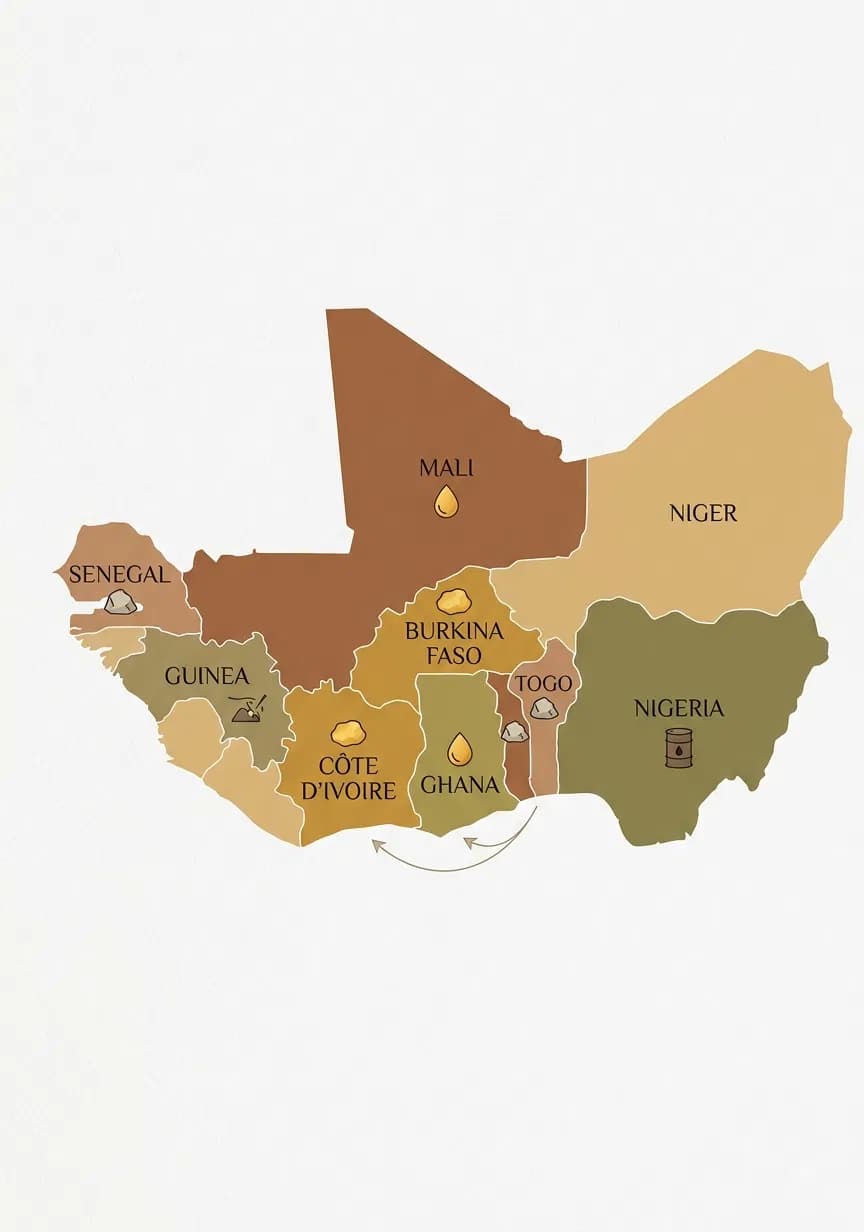
The recent strategy of JNIM in Mali illustrates this logic with chilling clarity. According to the Timbuktu Institute, the jihadists changed tactics by deciding to disrupt the country’s supply chains in order to destabilize and strangle the Malian economy, isolate the capital Bamako, and intensify economic pressure on the transitional regime deliberately targeting a region that produces nearly 80% of Mali’s gold and through which 30% of land imports, including fuel and cereals, transit. Since September 2025, JNIM has been attacking fuel tanker trucks coming from Senegal and Côte d’Ivoire, triggering the suspension of classes in schools and universities and paralyzing agricultural equipment during harvest season. Diesel prices rose by 29% by late March 2026, power and water outages multiplied across the capital, and Mali remains structurally vulnerable, dependent on imports for more than 90% of its petroleum products.
Causing all of this is part of the strategy. The blockade represents an evolution in JNIM’s tactics: rather than attempting to seize Bamako by force, the group uses economic warfare to demonstrate the government’s inability to protect basic services and supply chains. These actors have no interest in peace. Any approach that limits itself to awareness-raising without tackling the economic structures sustaining the war is doomed to fail not for lack of goodwill, but from a fundamental misreading of the adversary’s rationality.
What the Algerian Case Teaches
Algeria in the 1990s endured a comparable decade of violence, and its emergence from that crisis offers valuable operational lessons provided one resists the temptation to treat it as a perfect model. During the black decade, the Algerian economy recorded losses estimated at more than 20 billion dollars, and numerous large-scale projects were frozen for security reasons.
The resolution rested on three simultaneous pillars: sustained and uncompromising military pressure on the armed maquis, a credible legal and economic offer to combatants willing to lay down their arms including social and professional reintegration through business licenses and bank credits and the turning of internal actors, co-opting former armed group members to help thwart terrorist operations. In other words: peace was made economically more attractive than war for actors in a position to choose.
But the Algerian model carries a major limitation that the Sahel cannot afford to ignore: the illicit economic networks were not dismantled they migrated. The GSPC became AQIM, and later other branches emerged and took root in the Sahelian grey zones from which they had been pushed out of Algeria’s borders. Algeria’s peace partly externalized its war economy onto more fragile states and Mali, Niger, and Burkina Faso inherited it.
Toward a Political Economy of Lasting Peace
A serious peace economy in West Africa cannot be limited to post-conflict reconstruction. It requires acting on the structural drivers of violence economic exclusion of peripheral zones, marginalization of pastoral economies, absence of public services alongside the effective dismantling of the parallel economies that thrive in ungoverned spaces. This calls for strengthened customs and judicial cooperation, traceability mechanisms for cultural goods and illicit financial flows, economic alternatives capable of offering marginalized populations competitive legitimate incomes, and a disarmament program that is both credible and sustained.
The withdrawal of Mali, Burkina Faso, and Niger from ECOWAS in 2024 further weakens the regional prevention architecture at the very moment when conflict dynamics demand a stronger collective response. The stakes are economic in the most fundamental sense: societies that invest in peace accumulate human, social, and productive capital. Those that allow war economies to flourish transfer the cost to future generations with interest. All of this delays development, as funds meant to build the country flow in vast quantities into armaments enriching an arms industry that also thrives on instability. A labyrinthine cycle? Or a Pandora’s box?

Commenter
Les commentaires sont examinés avant publication.