
Real but Unfinished Modernization
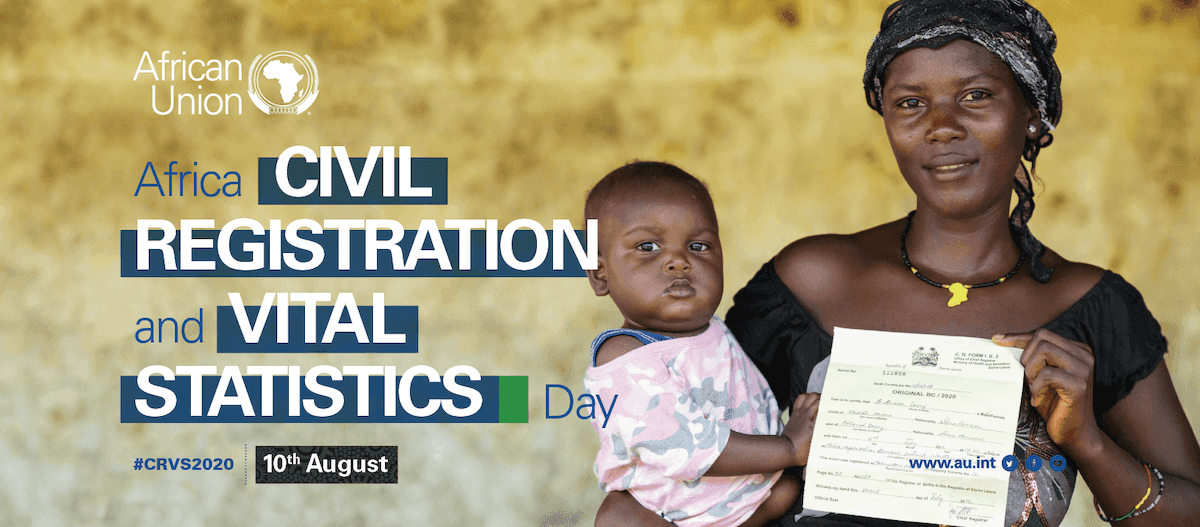
Civil registration is the bedrock of state organization. It records births, marriages, and deaths, guarantees citizens' identity, and determines their access to fundamental rights: education, health, justice, property. Without a birth certificate, an individual does not exist for the state. They cannot enroll in school, vote, inherit, or file a legal complaint.
The stakes therefore go beyond the mere upkeep of administrative registers. Civil registration is the first link in legal identity, a person's capacity to be legally recognized by the state and to effectively exercise their rights. This function is directly tied to Sustainable Development Goal 16.9, which aims to guarantee legal identity for all by 2030.
In sub-Saharan Africa, about 51% of children under five are registered. In Central Africa, that figure barely exceeds 60%. More alarming still: fewer than 30% of deaths are officially declared in several countries on the continent, meaning that nearly half of the region's children remain without an official record of their birth. This gap is not trivial. A deceased individual who is not removed from the registers continues to legally exist, and their identity can be reused indefinitely by ill-intentioned third parties.
Progress is nonetheless being made. Rwanda, Tanzania, and Uganda have brought services closer to citizens by integrating registration directly into maternity wards and health centers. Digitization is advancing, and several countries are relying on the CRVS strategy to reach the UN's goal of legal identity for all by 2030. But modernization remains uneven, underfunded, and too often disconnected from the security issues it nonetheless directly conditions.
Ghost Children and Adults: When Invisibility Becomes a Security Flaw
The deficit is considerable: about 90 million children under five in sub-Saharan Africa, according to the World Bank and UNICEF, are not registered at birth. On their own, they represent more than half of the world's unregistered children. And the absence of registration is only part of the problem: 21 million other children, though recorded as registered, still do not have a birth certificate. In total, more than 110 million children under five in the region therefore lack documentary proof of their birth. These ghost children, joined by millions of adults who were never registered, represent far more than an administrative statistic. They constitute a structural security flaw that armed groups and cross-border criminal networks methodically exploit.
During armed conflicts, combatants deliberately blend into flows of displaced civilians. Faced with an adult with no administrative history whatsoever, security forces and humanitarian agencies are unable to distinguish a fleeing farmer from a clandestine combatant. For unregistered children, the risk is different but equally serious. A child who does not exist administratively can be abducted, recruited as a child soldier, or become a victim of trafficking without any alert ever being raised. They are never reported missing, since officially they never existed. These minors thus feed cross-border networks of forced labor, organ trafficking, and prostitution in near-total impunity.
It should be noted that these unregistered children do not in themselves constitute a security threat. They do, however, represent an institutional vulnerability: when a population remains largely outside legal identity systems, the state's capacity to protect people, document displacement, prevent certain forms of trafficking, and establish family links in crisis situations is diminished.
The Absence of a Regional Database: The Paradox of Free Movement
ECOWAS liberalized the movement of people and goods to boost regional economic integration. That is a genuine advance. But allowing millions of people to move freely without first harmonizing and interconnecting legal identity systems has created a major security imbalance that official bodies still struggle to name frankly.
Without mechanisms to reliably and securely verify an identity from one state to another, an individual flagged in one state can cross the border and blend into the neighboring population without leaving a trace. Identity fraud thrives: the same person can obtain genuine-but-fraudulent official documents in two or three different countries by exploiting the local weaknesses of each system. Cross-border arrest warrants remain largely ineffective for lack of capacity to authenticate, in real time, the identity of an intercepted suspect.
The real challenge, then, is not necessarily to create a centralized regional database, but to enable controlled interoperability between national systems. A state must be able to verify, within a strict legal framework, that an identity presented at its border corresponds to an identity legally established in another state, without this implying unlimited circulation of personal data.
Recent political fragmentation has worsened this situation. Tensions between the Alliance of Sahel States and ECOWAS have seriously slowed the sharing of sensitive data between member and former member countries. What was already insufficient cooperation has become, in certain corridors, no cooperation at all. Sahelian armed groups, which operate precisely in these spaces of institutional rupture, draw considerable operational advantage from this. This situation illustrates the real challenge: it is not just about allowing people to cross borders, but about building compatible identification systems capable of simultaneously preserving mobility, security, and data protection.
Cybercrime: Are We Ready for Interconnection?
The answer is clear: no. Digitizing civil registries without securing the infrastructure would be like building a safe with a cardboard door. Cyberattacks cost African countries an average of 10% of GDP each year. Nearly 90% of administrations on the continent have no basic cybersecurity protocol. Fewer than half of African states have adopted strict personal data protection laws.
In this context, a hasty regional interconnection of civil registration databases would create a single entry point for hackers. The domino effect would be devastating: breaching the weakest link in the chain would be enough to access the identity data of millions of citizens across several countries simultaneously. Ransomware attacks, which already paralyze African hospitals and administrations, could block access to birth and identity registers for an entire sub-region, giving criminals an unprecedented lever of blackmail against sovereign states.
The trend emerging among the continent's most advanced countries, Senegal, Côte d'Ivoire, Rwanda, Morocco, Ghana, is one of digital sovereignty before interconnection: storing sensitive data on secure national servers, adopting binding cybercrime legislation, and training local information security engineers. This is the precondition for any viable regional architecture.
Internal Corruption and Gender: Human and Structural Flaws
The flaw is not purely technological. It is also deeply human. Judicial investigations in Senegal have uncovered networks trafficking civil status documents operated from within by municipal officials. In exchange for payment, foreigners or wanted individuals obtain genuine-but-fraudulent birth certificates that allow them to access official documents and evade intelligence services. Mobile court sessions (audiences foraines), the catch-up processes meant to regularize honest undocumented residents, are themselves infiltrated by criminal networks seeking to naturalize false citizens. As long as civil registration officials remain underpaid and unprotected, corruption will remain as effective an entry point as any cyberattack.
To this flaw is added a gender dimension that is systematically underestimated. Women and girls are overrepresented among unregistered people, particularly in rural areas. This administrative invisibility structurally excludes them from access to land ownership, inheritance, healthcare, and justice. A woman without a birth certificate can neither assert her rights in the event of divorce or widowhood, nor pass on a legal identity to her children. Civil registration is thus a matter of equality as much as of security.
Democracy, Humanitarian Law, and Invisibility: What Is Not Said Enough
Elections held without a reliable civil register produce electoral rolls inflated with ghosts, duplicates, foreign nationals from neighboring countries, and the dead. This is not a hypothesis: it is a documented reality in several contested African elections. The legitimacy of results is thus undermined not solely by intentional fraud, but by a structural failure upstream in administration. Reforming civil registration also means strengthening democracy.
In situations of armed conflict, the absence of registration prolongs violence beyond the fighting itself. A child who is a victim of war and does not exist administratively cannot officially be reported missing, cannot receive reparations, and cannot be legally reunited with their family. Legal invisibility erases victims twice: once in life, and again in the historical record.
Responses Underway: Between Innovation and Limits
Faced with these challenges, responses do exist. The BIMS system deployed by UNHCR in Sahel refugee camps captures fingerprints, iris scans, and facial recognition to fix a person's identity at the moment they cross a border, blocking multiple registrations and identity theft. Niger has innovated by integrating birth registration directly into vaccination campaigns and authorizing its military units to record civil status events in conflict zones. A national biometric registration agency has been created to link each identity to unique physical data from the earliest age.
These initiatives are real and deserve recognition. But they remain responses to symptoms. BIMS cannot identify a total stranger presenting themselves for the first time. Field military registration does not cover areas where the state has entirely disappeared. And sovereignty over this data often remains in the hands of international agencies rather than the states concerned.
A birth certificate is not just another document. It is a state's first act of sovereignty over its territory and a citizen's first right over their own existence. The priority should therefore be less about building a single architecture than about progressively constructing an African ecosystem of legal identity: reliable national systems, interoperable according to common standards, protected by robust cybersecurity and data protection frameworks, and accessible to populations furthest from public services. The challenge is to build an interconnection that strengthens state sovereignty without turning citizens identity into data that circulates without limits.
SOURCES:
- Institutional Reports & Statistics (World Bank, UNICEF, UN) World Bank. (2022). Global dataset on identification: Executive summary. World Bank Group. https://id4d.worldbank.org
ECA. (2021). Assessment report on the progress of the APAI-CRVS programme in Africa. United Nations Economic Commission for Africa. https://www.uneca.org
UNICEF. (2019). Birth registration for every child by 2030: Are we on track? UNICEF Division of Data, Analytics and Research. https://data.unicef.org/resources/birth-registration-for-every-child-by-2030/
UNICEF. (2023). Statistical profile on birth registration in Sub-Saharan Africa. UNICEF Data. https://data.unicef.org
- Cybersecurity & Digital Sovereignty INTERPOL. (2023). African cyberthreat assessment report 2023. Interpol Cybercrime Directorate. https://www.interpol.int
Serianu. (2022). Africa cybersecurity report 2021/2022: Enforcing cybersecurity compliance in Africa. Serianu Limited. https://www.serianu.com
African Union. (2014). African Union Convention on Cyber Security and Personal Data Protection (Malabo Convention). African Union. https://au.int
ITU. (2021). Global cybersecurity index 2020. International Telecommunication Union. https://www.itu.int
- Refugees, Migration & Cross-Border Security ECOWAS. (1979). Protocol A/P.1/5/79 relating to Free Movement of Persons, Residence and Establishment. Economic Community of West African States.
UNHCR. (2020). Biometric identity management system (BIMS) operational handbook. United Nations High Commissioner for Refugees. https://www.unhcr.org
IOM. (2021). Analysis of migration flows and border management in West Africa. International Organization for Migration. https://www.iom.int
- Gender, Corruption & Human Rights UNODC. (2020). Global report on trafficking in persons 2020. United Nations Office on Drugs and Crime. United Nations publication.
UN Women. (2021). Women's access to land rights and legal identity in West Africa. United Nations Entity for Gender Equality and the Empowerment of Women. https://www.unwomen.org
UNDP. (2022). Democratic governance and strengthening civil registration capacities in Africa. United Nations Development Programme. https://www.undp.org

Commenter
Les commentaires sont examinés avant publication.